
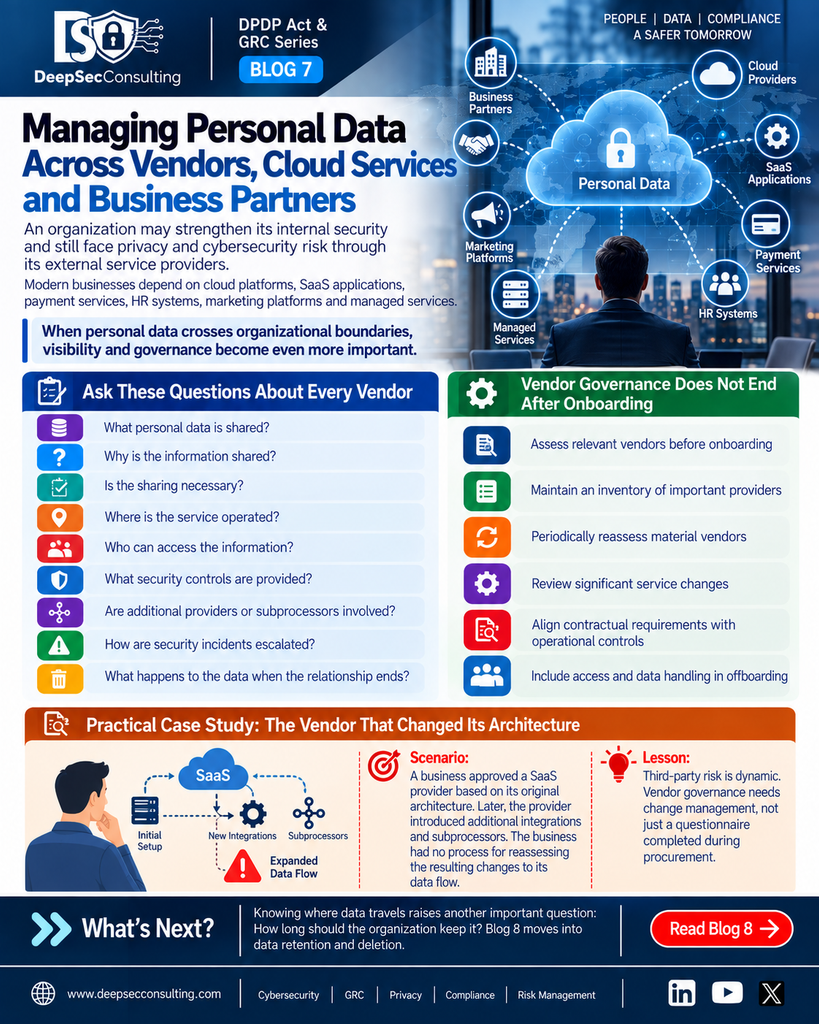
Managing personal data across vendors, cloud services and business partners
DeepSec Consulting | DPDP Act & GRC Series
An organization may strengthen its internal security and still face privacy and cybersecurity risk through its external service providers.
Modern businesses depend on cloud platforms, SaaS applications, payment services, HR systems, marketing platforms and managed services.
When personal data crosses organizational boundaries, visibility and governance become even more important.
Ask These Questions About Every Vendor
- What personal data is shared?
- Why is the information shared?
- Is the sharing necessary?
- Where is the service operated?
- Who can access the information?
- What security controls are provided?
- Are additional providers or subprocessors involved?
- How are security incidents escalated?
- What happens to the data when the relationship ends?
Vendor Governance Does Not End After Onboarding
- Assess relevant vendors before onboarding
- Maintain an inventory of important providers
- Periodically reassess material vendors
- Review significant service changes
- Align contractual requirements with operational controls
- Include access and data handling in offboarding
Practical Case Study: The Vendor That Changed Its Architecture
Scenario: A business approved a SaaS provider based on its original architecture. Later, the provider introduced additional integrations and subprocessors. The business had no process for reassessing the resulting changes to its data flow.
Lesson: Third-party risk is dynamic. Vendor governance needs change management, not just a questionnaire completed during procurement.
What’s Next?
Knowing where data travels raises another important question: How long should the organization keep it? Blog 8 moves into data retention and deletion.
DeepSec Consulting can help organizations assess DPDP readiness, identify privacy and security gaps, and build a practical GRC roadmap aligned with their business environment.
No comments