
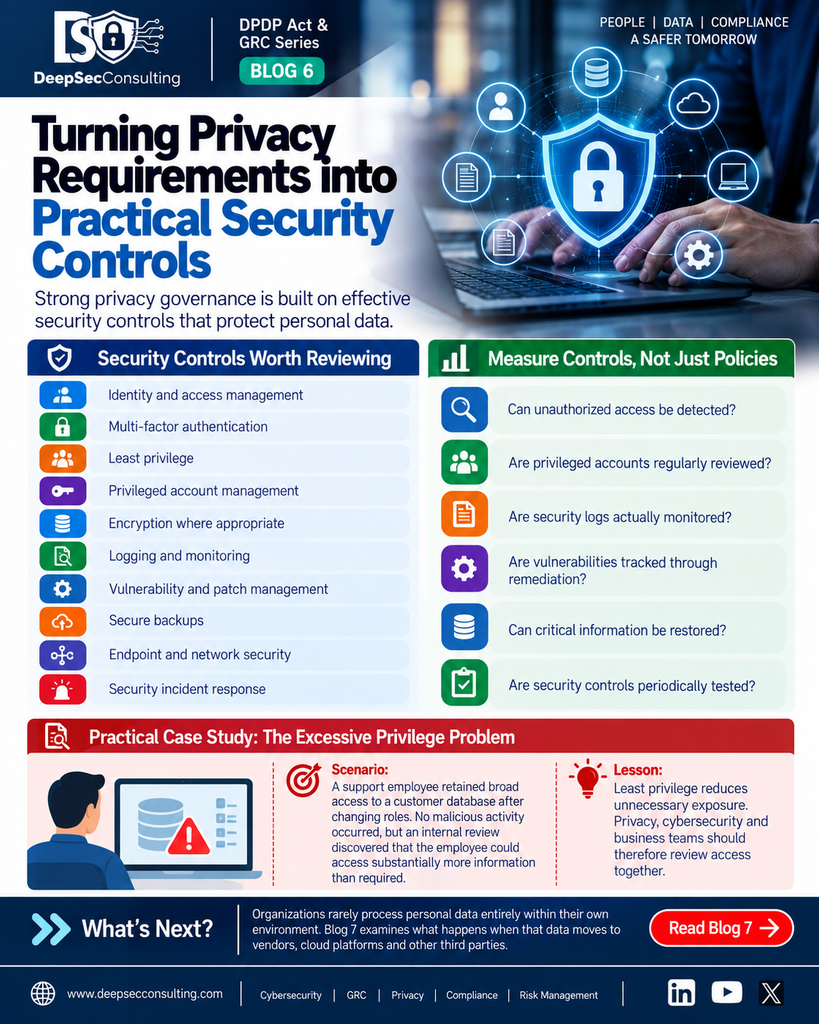
Turning privacy requirements into practical security controls
DeepSec Consulting | DPDP Act & GRC Series
The journey so far has focused on understanding personal data, mapping its movement, communicating with individuals and building operational privacy processes.
The next question is critical: How is that personal data actually protected?
Privacy governance cannot depend on documents alone. Access controls, authentication, monitoring, vulnerability management, secure configurations, backups and incident response all contribute to protecting personal data.
Security Controls Worth Reviewing
- Identity and access management
- Multi-factor authentication
- Least privilege
- Privileged account management
- Encryption where appropriate
- Logging and monitoring
- Vulnerability and patch management
- Secure backups
- Endpoint and network security
- Security incident response
Measure Controls, Not Just Policies
- Can unauthorized access be detected?
- Are privileged accounts regularly reviewed?
- Are security logs actually monitored?
- Are vulnerabilities tracked through remediation?
- Can critical information be restored?
- Are security controls periodically tested?
Practical Case Study: The Excessive Privilege Problem
Scenario: A support employee retained broad access to a customer database after changing roles. No malicious activity occurred, but an internal review discovered that the employee could access substantially more information than required.
Lesson: Least privilege reduces unnecessary exposure. Privacy, cybersecurity and business teams should therefore review access together.
What’s Next?
Organizations rarely process personal data entirely within their own environment. Blog 7 examines what happens when that data moves to vendors, cloud platforms and other third parties.
DeepSec Consulting can help organizations assess DPDP readiness, identify privacy and security gaps, and build a practical GRC roadmap aligned with their business environment.
No comments