
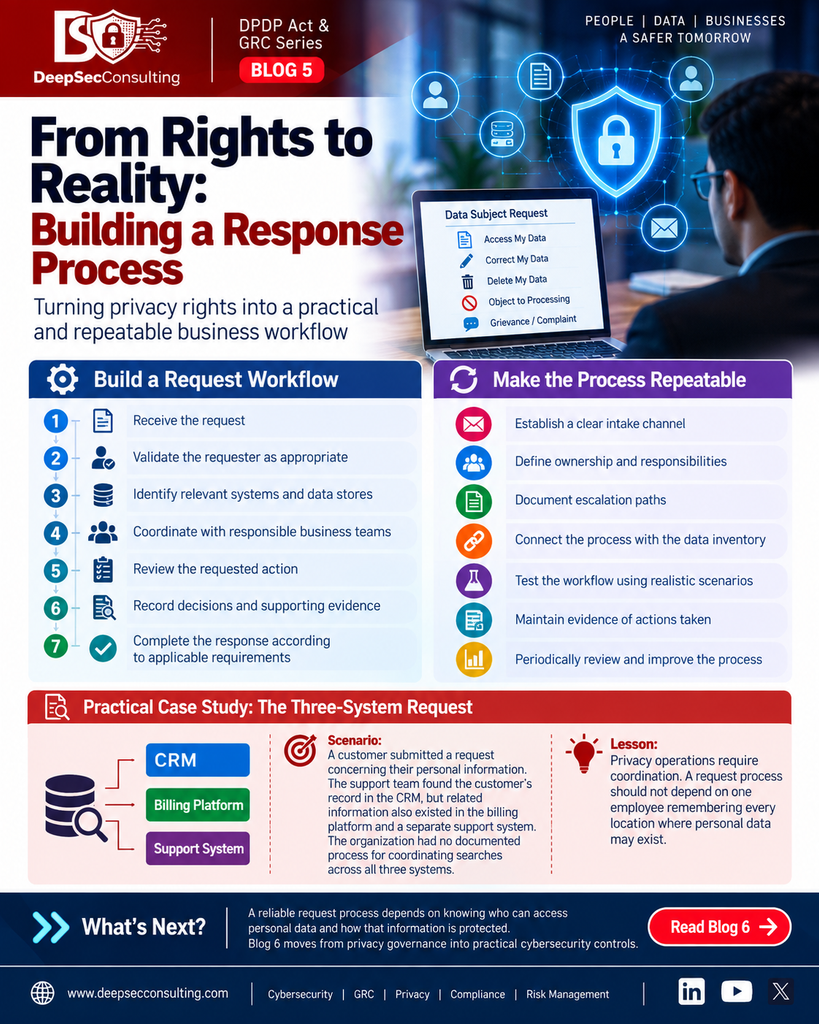
Turning privacy rights into a practical and repeatable business workflow
DeepSec Consulting | DPDP Act & GRC Series
In Blog 4, we looked at privacy notices and consent—the information presented to individuals when their personal data is collected.
But transparency is only the beginning.
Organizations also need an operational process for handling requests, questions and grievances relating to personal data. A privacy program becomes effective when business, technology, security and compliance teams know what to do when a request arrives.
The challenge is often not writing the policy. It is finding the relevant data across multiple systems and coordinating the response.
Build a Request Workflow
- Receive the request
- Validate the requester as appropriate
- Identify relevant systems and data stores
- Coordinate with responsible business teams
- Review the requested action
- Record decisions and supporting evidence
- Complete the response according to applicable requirements
Make the Process Repeatable
- Establish a clear intake channel
- Define ownership and responsibilities
- Document escalation paths
- Connect the process with the data inventory
- Test the workflow using realistic scenarios
- Maintain evidence of actions taken
- Periodically review and improve the process
Practical Case Study: The Three-System Request
Scenario: A customer submitted a request concerning their personal information. The support team found the customer’s record in the CRM, but related information also existed in the billing platform and a separate support system. The organization had no documented process for coordinating searches across all three systems.
Lesson: Privacy operations require coordination. A request process should not depend on one employee remembering every location where personal data may exist.
What’s Next?
A reliable request process depends on knowing who can access personal data and how that information is protected. Blog 6 moves from privacy governance into practical cybersecurity controls.
DeepSec Consulting can help organizations assess DPDP readiness, identify privacy and security gaps, and build a practical GRC roadmap aligned with their business environment.
No comments